N NorthlineCoating

The equipment
behind the finish —
spec by spec.

Every shop claims to have "state-of-the-art equipment." This page shows exactly what we run: manufacturers, models where relevant, capacities, tolerances, and the practical limits of our line. If you're an engineer or a project manager evaluating coaters, this is the reference sheet.

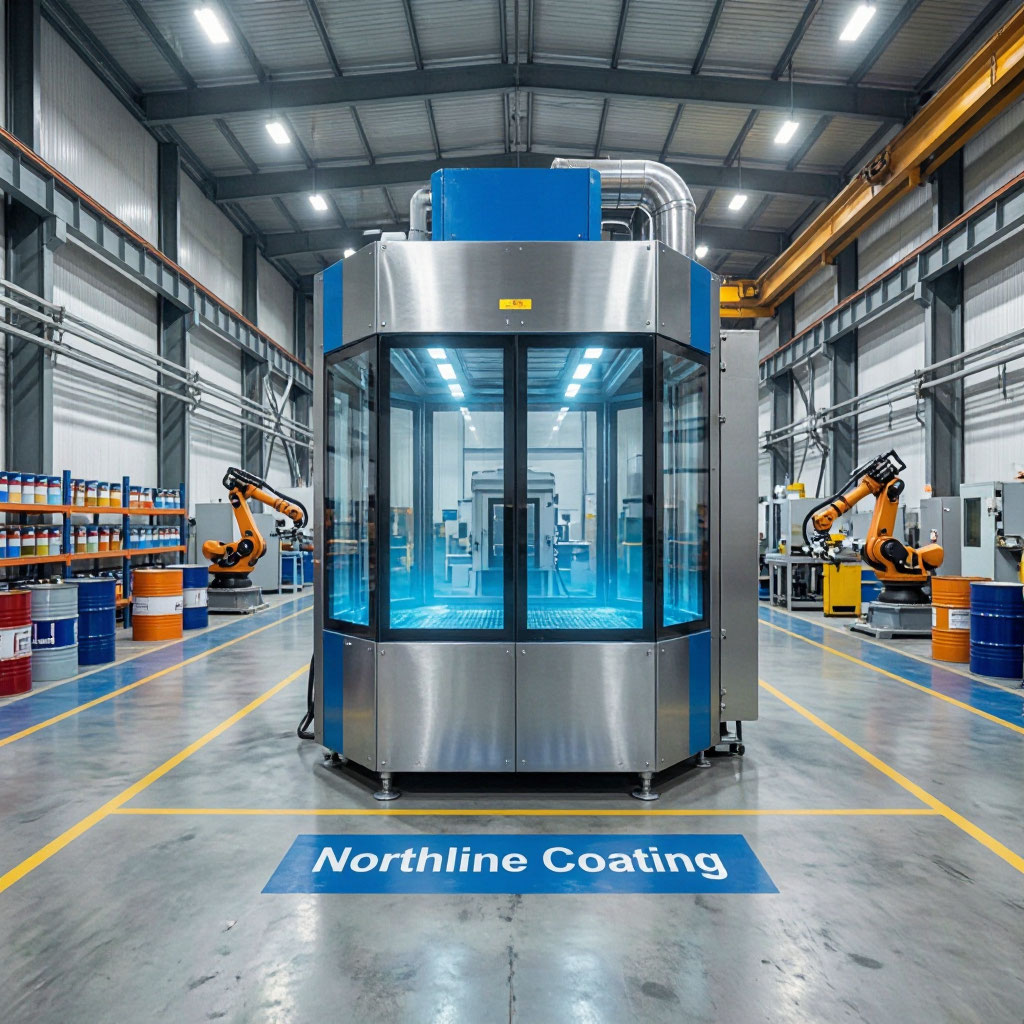
Northline Coating production floor with powder application booth and equipment
Overview

A line built
for flexibility,
not just volume.

Our equipment choices have been driven by a specific goal: to be able to coat almost anything a customer sends us, from a single prototype part to a 3,000-piece production run, with the same quality of finish. That's a harder target than it sounds — production coaters usually optimize for speed and volume, which means small or complex jobs get pushed to the back of the line.

We run two independent coating cells, each with its own booth, guns, and rack setup. Cell 1 handles heavy industrial and architectural work with automated reciprocators and larger ovens. Cell 2 handles smaller, more detailed work — automotive, custom, and prototype jobs — with manual application and touch-up capability. Both cells share the same pretreatment line, cure ovens, and QC process.

The facility is a 48,000 square foot building on Burton Street in Grand Rapids, with an enclosed loading dock, a dedicated blast room, and a QC lab. We don't run a second or third shift — everything is scheduled across a single first shift so equipment is always operated by trained staff, not third-shift fill-ins.

01
Powder Application

Application equipment.

We run Nordson HDLV powder delivery systems in both cells. HDLV (High-Density, Low-Velocity) pumping moves powder through the system in dense slugs with less air velocity than traditional venturi pumps — this results in more consistent transfer efficiency, better film build control, and less overspray waste. In practice, it means the powder lands on the part where it's supposed to, not in the reclaim system.

Cell 1 has a Nordson ColorMax booth with automated reciprocators and a 12-gun setup for high-volume production work. Cell 2 has a smaller manual Nordson Encore HD booth for detail work, touch-up, and short runs. Both booths have quick-change powder feed to allow color changes without a full teardown.

Delivery systems Nordson HDLV pumps (both cells)
Cell 1 booth Nordson ColorMax · 12-gun auto reciprocator
Cell 2 booth Nordson Encore HD · manual with touch-up
Guns Nordson Encore HD electrostatic, 100 kV
Overspray reclaim Nordson reclaim cyclones · 92%+ recovery
Powder materials AkzoNobel, PPG, Sherwin-Williams, Tiger
02
Pretreatment

Blast & pretreatment line.

Pretreatment is where coating quality is actually made. Our line handles both ferrous and non-ferrous substrates with two parallel processes: mechanical (blasting) and chemical (7-stage iron phosphate). Most production parts get both — blast to remove mill scale and create a surface profile, then chemical pretreatment for a conversion coating that the powder chemically bonds to.

The 7-stage iron phosphate line runs alkaline clean → rinse → rinse → iron phosphate → rinse → rinse → DI rinse → dry-off. Cycle time is 22 minutes at full throughput. The line is monitored continuously for bath concentration, temperature, and pH — logs are kept per run and are available for customer QA files.

Aluminum parts go through a chromate conversion pretreatment instead of iron phosphate. Same 7-stage approach, different chemistry. We also run a chrome-free conversion option for projects with specific environmental requirements.

Phosphate line 7-stage iron phosphate, 22-min cycle
Blast cabinets Two pressure blast cabinets + walk-in blast room
Blast media Aluminum oxide, 80 – 120 grit
Aluminum pretreatment Chromate conversion or chrome-free
DI rinse Deionized water, 18 MΩ resistance
Max part through line 24 ft × 60 in × 72 in
03
Cure Ovens

Batch ovens & cure.

We run two gas-fired batch ovens, each with independent temperature control and its own data logging. Batch ovens (as opposed to conveyor ovens) allow us to cure parts of different sizes in the same cycle, and to run low-temperature cure schedules for heat-sensitive parts without disrupting the rest of the line.

Both ovens maintain ±5°F of setpoint across the full chamber, which is the tolerance required for consistent powder cure. Every cure cycle is logged with time-in, time-to-temperature, dwell time, and time-out. Logs are archived by lot number for the duration required by our ISO 9001 procedures — currently a minimum of three years.

For low-temperature powders (250°F – 300°F), we use the same ovens with an extended dwell schedule. Low-temp cure takes roughly 60% longer than standard cure, which is factored into the quoted turnaround when the customer specifies low-temp.

Oven count Two independent batch ovens
Max part size per oven 24 ft × 60 in × 72 in
Max load per cycle 2,000 lb per rack, multiple racks per cycle
Standard cure 350°F – 400°F, dwell per powder spec
Low-temp cure 250°F – 300°F, extended dwell
Temperature tolerance ±5°F across full chamber
Cycle logging Time/temp data per cycle, archived 3+ years
04
Quality Control

QC lab & instruments.

Our QC lab is a separate, climate-controlled room off the main floor. Every production lot goes through final inspection here before it's released for shipping. The lab houses the measurement instruments, reference samples, and documentation systems that support our ISO 9001 process.

Film thickness is measured with calibrated electronic dry-film gauges — we use multiple gauges so that a single instrument failure doesn't halt a production run. Adhesion testing uses cross-hatch and impact methods per ASTM standards. Color verification is done with a spectrophotometer against retained reference samples from approved production batches.

We also run our own salt-spray cabinet for periodic corrosion testing. This isn't for every lot — it's for validating new systems, verifying customer-specified test requirements, and for annual re-verification of our standard processes. Salt spray results are reported in hours to first red rust and hours to 5% red rust.

Film thickness gauge PosiTector 6000 · multiple calibrated units
Adhesion testing Cross-hatch per ASTM D3359 · impact per ASTM D2794
Color verification Spectrophotometer · ΔE measurement against reference
Salt spray cabinet In-house ASTM B117, up to 3,000 hr capability
Gloss measurement Gloss meter at 60° angle per ASTM D523
Retained samples Approved color panels archived per project
05
Masking

Masking equipment.

Masking is one of the least visible parts of the coating process and one of the most detail-heavy. Every surface that needs to stay bare — threads, bores, mating faces, electrical contacts, hub seats — has to be masked before powder application and un-masked after cure. Bad masking ruins good coating jobs.

We use high-temperature silicone plugs, caps, and tapes that survive the 400°F cure cycle without shrinking or leaving residue. Standard masking tape breaks down at cure temperature and leaves adhesive; silicone masking doesn't. For complex parts with many masked features, we build reusable masking fixtures that hold every plug in the correct position — this speeds up masking on every part in a production run and prevents missed masks.

Masking materials High-temp silicone plugs, caps, tapes
Plug sizes #4 (0.125") through 2" thread and bore diameters
Tape temperature rating Up to 500°F sustained
Production masking fixtures Custom-built per part for recurring runs
Post-cure inspection All masked surfaces verified bare
06
Material Handling

Loading & staging.

The facility has a dedicated loading dock with 53-foot trailer access and a separate inbound/outbound staging area. Parts never cross the coating floor between receipt and shipping — this prevents contamination from settled powder, cutting fluids, or dust. The receiving bay handles inbound freight and the loading dock handles outbound.

Inside the shop, we run two 5,000 lb forklifts and a 2-ton overhead bridge crane for moving heavy parts between stations. Racking systems are configured per job — from simple ground racks to custom hanging fixtures for long architectural extrusions. Rack storage is separated by lot so parts don't get mixed between jobs.

Dock access Dedicated dock · 53 ft trailer access
Inbound staging Separate receiving bay, enclosed
Forklifts Two, 5,000 lb capacity
Overhead crane 2-ton bridge crane, full bay coverage
Rack storage Dedicated rack area per lot
Shipping LTL, flatbed, customer freight coordination
Capability matrix

What we can
and can't do.

Every coater has limits. These are ours, stated plainly so you can decide before sending a drawing.

Parameter Capability Notes
Max part length 24 ft (7.3 m) Larger parts can sometimes be run segmented or referred out
Max part width 60 in (1,524 mm) Limited by oven and booth opening
Max part height 72 in (1,829 mm) Includes racking height
Max weight per rack 2,000 lb (907 kg) Multiple racks can run per cycle
Film thickness range 1.5 – 15 mil Heavy-build requires two-coat primer + topcoat
Cure temperature range 250°F – 400°F Low-temp extends dwell time by ~60%
Substrates accepted Steel, stainless, aluminum, cast iron, forged alloys No wood, plastic, composite, or heat-sensitive assemblies
Standard turnaround 3 – 5 business days Custom colors and two-stage finishes add 2–15 days
Minimum quantity 1 part Practical minimum is ~$150 total job value
Not offered Anodizing, plating, ceramic coating We refer these to trusted specialists
Not offered Coating over wood, plastic, or composites Substrate can't survive cure temperature
Not offered ITAR or DFARS certified work We provide conformance documentation, but aren't certified
Facility at a glance

Northline Coating,
by the numbers.

0 Square feet of production space
0 Independent coating cells
0 Batch cure ovens
0 Full-time employees
0 % powder reclaim rate
0 Production lots since 2005
Equipment FAQ

Questions from
engineers.

Can I tour the facility and see the equipment?

Yes. We welcome facility tours for fabricators, engineers, and project managers who are evaluating us for ongoing work. Tours typically take 30–45 minutes and cover the full line from receiving through application, cure, and QC. Call Maria directly at (616) 452-8817 to schedule.

What happens if a part exceeds your size limits?

We'll tell you honestly during the quote. For parts slightly over our limits, we can sometimes coat them by segmenting or running them across multiple racks. For parts significantly over, we refer you to a shop with a larger oven — there are two in West Michigan we work with regularly. We'd rather refer you than take a job we can't do well.

Do you run a second shift or third shift?

No. We run a single first shift Monday through Friday, 7:00am to 3:30pm. Overtime is available when needed, but we don't operate a night shift. This keeps every production cycle under the supervision of trained staff who know the equipment.

Can you provide equipment calibration records?

Yes. All measurement instruments — film thickness gauges, spectrophotometer, gloss meter, oven thermocouples — are on a documented calibration schedule and are calibrated against NIST-traceable standards. Calibration records are available on request as part of a customer QA file.

What does your reclaim system actually recover?

Overspray powder is captured by the booth's reclaim cyclone and returned to the feed system. We recover 92%+ of overspray, which reduces waste disposal and improves cost efficiency. Reclaimed powder is blended into the feed at a ratio that maintains color consistency — typically no more than 20% reclaimed to 80% virgin powder for critical color work.

Do you have capacity for a large recurring production job?

Depends on the specifics. Our two cells can run in parallel when needed, giving us significant throughput. We schedule recurring production jobs on reserved slots — monthly, quarterly, or seasonal — so capacity is guaranteed. If you're evaluating us for a production contract, contact us before the RFQ deadline to discuss scheduling.

What powder brands do you run?

We work with four primary suppliers: AkzoNobel, PPG, Sherwin-Williams, and Tiger Drylac. Different manufacturers are specified for different systems — architectural PVDF work usually runs AkzoNobel or PPG, industrial epoxies often run Tiger, and automotive custom colors vary by project. We can spec a specific manufacturer's system if your project calls for it.

Can you provide a certificate of conformance with the equipment data?

Yes. Every shipment includes a certificate of conformance documenting the powder manufacturer and batch, cure log (times and temperatures), film thickness readings per rack, operator initials, and QC sign-off. Additional documentation — calibration records, adhesion test results, salt-spray hours — is available on request for projects that require it.

Spec your next job

Send us the drawing.
We'll tell you what
we can run.

If you're an engineer evaluating coaters, send us the part details and we'll respond with an honest assessment of whether our equipment can handle it — and if not, who can. No pressure, no fluff.